Why traditional advisory relationships fail growth-stage companies, and what works instead.
It usually starts with a handshake and a promise. A growth-stage founder, acutely aware of their own blind spots, brings on an industry veteran as an advisor. The compensation is a tidy 0.5% equity grant vesting over two years. The expectation? Transformative, battle-tested wisdom that will help the startup scale past its immediate hurdles.
The reality? A one-hour quarterly Zoom call that feels more like an investor update than a strategic working session.
By the time the advisor is brought up to speed on the last three months of chaotic pivots, personnel changes, and product iterations, there are only ten minutes left for actual advice. The resulting guidance is often sound in theory but completely detached from the messy, on-the-ground reality the founder is actually navigating.
For growth-stage companies—where context decays in weeks, not years—the traditional advisory model is fundamentally broken. It's time for a pragmatic shift toward what actually works: The Embedded Adviser Model.
The Flaw in the "Drop-In" Model
The fatal flaw of traditional advisory isn't a lack of expertise; it's a lack of context.
Startups operating between Seed and Series B are high-velocity environments. Decisions are made in Slack threads, during impromptu stand-ups, and in the margins of customer calls. When an advisor sits outside this operational slipstream, they can only offer generic playbooks. They say, "You need to tighten your sales cycle," when what the founder actually needs is someone to look at their CRM data and say, "Your account executives are dropping the ball between the demo and the technical validation step—let's rewrite that specific sequence."
The Context Problem
Wisdom without context is just a platitude. And founders don't need more platitudes. They need someone who understands the specific constraints, personalities, and dynamics of their business right now—not someone reciting lessons from a company that operated in a different market, a different era, with different resources.
The Hidden Costs of Low-Context Advice
When advisors lack operational context, their recommendations often create more work than they solve. Consider the common failure modes:
- Misaligned prioritisation: The advisor suggests hiring a VP of Sales when the real bottleneck is product-market fit refinement. Three months and $150K later, the VP churns because there was nothing ready to sell at scale.
- Framework overload: Generic best practices get layered onto a team that's already stretched thin. The founder now has a beautiful OKR system that nobody has time to maintain.
- Delayed decision-making: Critical choices get postponed until the next advisory call, when the optimal window has already closed.
- Surface-level diagnosis: Without access to the actual data, advisors pattern-match to past experiences that may not apply. "This sounds like what happened at my last company" is not a diagnostic methodology.
Enter the Embedded Adviser
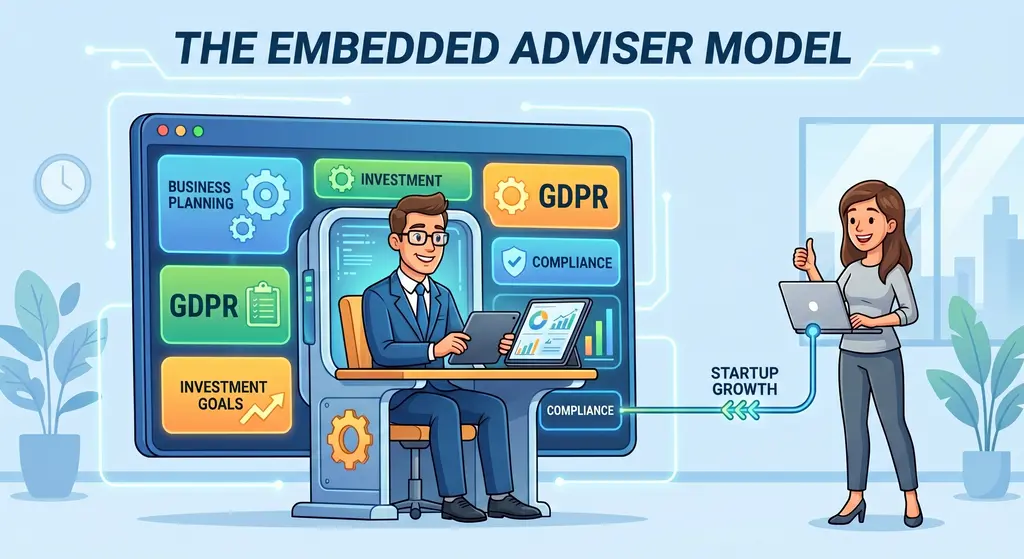
The Embedded Adviser model bridges the gap between a detached consultant and a full-time executive. Instead of dispensing high-level advice from the bleachers, an embedded adviser gets on the field.
They are given a company email address. They live in your Slack workspace. They have access to your Notion docs, your Figma files, or your Jira boards. They don't just tell you what to do; they understand the constraints of your current team and help you figure out how to do it.
Traditional Advisory vs. Embedded Advisory
What "Embedded" Actually Means
Being embedded doesn't mean working full-time or attending every meeting. It means having enough continuous exposure to the business that context doesn't need to be rebuilt from scratch in every interaction. Practically, this looks like:
Passive Context Absorption
Being CC'd on key email threads. Lurking in strategic Slack channels. Reviewing weekly metrics dashboards. The adviser stays informed without requiring active updates, preserving founder bandwidth.
On-Demand Availability
A five-minute voice note when a decision needs to be made. A quick review of a pitch deck before it goes out. Access patterns that match the actual rhythm of startup decision-making, not artificial quarterly cadences.
Selective Deep Dives
Concentrated involvement during critical moments—fundraising sprints, executive hires, strategic pivots—where having an experienced co-pilot materially changes outcomes.
Core Pillars of the Embedded Approach
If you are transitioning to or hiring for this model, the relationship should be built on three pragmatic pillars:
1. High-Context, Low-Friction Access
The best advice happens asynchronously and in the moment. An embedded adviser is available for a five-minute voice note or a quick review of a pitch deck draft before it goes out. Because they are constantly absorbing the ambient information of the company through passive channels (like being CC'd on key updates or lurking in the #product-strategy channel), they don't need a 30-minute preamble to answer a question.
This changes the economics of seeking advice. When getting guidance requires scheduling a formal call and preparing a briefing document, founders will only reach out for "big" decisions. But startup success often hinges on hundreds of small decisions made correctly. Low-friction access means the adviser's judgment gets applied to the full spectrum of choices, not just the ones that feel important enough to warrant a meeting.
Practical Tip
Set up a dedicated Slack channel or shared workspace from day one. The adviser should be able to see the flow of work without needing to ask for updates. When they do engage, they're already primed with context.
2. Fractional Execution
Traditional advisors pontificate; embedded advisers participate. While they shouldn't be doing the job of a full-time employee, they should be willing to roll up their sleeves. This might mean:
- Interviewing a crucial VP-level hire and providing detailed candidate assessment
- Facilitating a quarterly planning offsite when internal dynamics make self-facilitation ineffective
- Co-authoring a critical strategy document rather than just reviewing it
- Joining a key customer call to provide real-time coaching
- Building the first draft of a compensation framework or equity allocation model
The goal isn't to create dependency—it's to model what good execution looks like so your internal team can ultimately internalise it and take over. The best embedded advisers are constantly working themselves out of specific tasks by transferring capability to the team.
3. Truth-Telling Without the Politics
An embedded adviser is uniquely positioned: they are close enough to the metal to know where the bottlenecks are, but detached enough from the org chart to speak the unvarnished truth. They don't have to worry about the next promotion cycle or internal turf wars.
This makes them the perfect sounding board for a CEO who needs someone to say, "Your current go-to-market strategy is failing, and the metrics your team is reporting are masking the real issue." Or: "Your co-founder isn't scaling with the company, and everyone knows it except you."
Internal executives often can't deliver this feedback—they have relationships to preserve, political capital to protect, and careers that depend on not being the messenger of bad news. Board members might deliver it, but usually too late and with insufficient operational detail to be actionable. The embedded adviser occupies a unique position in the trust hierarchy: close enough to see clearly, independent enough to speak freely.
The Trust Hierarchy: Where Embedded Advisers Fit
Low Context"| FEEDBACK["CEO
Decision Making"]:::ceo B --> |"Balanced Authority
& Context"| FEEDBACK C --> |"High Context
Political Constraints"| FEEDBACK D --> |"Ground-Level
Limited Access"| FEEDBACK classDef board fill:#3D3835,stroke:#9C9A95,stroke-width:2px,color:#F5F3EE classDef embedded fill:#1E3D36,stroke:#2A9A88,stroke-width:2px,color:#F5F3EE classDef exec fill:#3D2A27,stroke:#A84438,stroke-width:2px,color:#F5F3EE classDef emp fill:#3A3D35,stroke:#8AA06A,stroke-width:2px,color:#F5F3EE classDef ceo fill:#7A2E22,stroke:#7A2E22,stroke-width:2px,color:#F5F3EE
Structuring the Engagement
Implementing this model requires a shift in how you compensate and scope the work.
Compensation Models That Align Incentives
Drop the multi-year vesting schedules for people you rarely speak to. Instead, structure agreements around models that require and reward active participation:
Monthly Retainer
A fixed monthly fee that covers a defined scope of availability and involvement. Creates predictable economics for both parties and can be adjusted as needs change. Typical range: $3,000–$15,000/month depending on seniority and time commitment.
Milestone-Based Equity
Equity that vests upon completion of specific, measurable outcomes rather than mere passage of time. "0.25% upon successful Series A close" aligns incentives far better than "0.5% over 24 months regardless of contribution."
Hybrid Structure
A smaller monthly retainer plus milestone equity. The retainer covers ongoing availability; the equity provides upside for significant impact. This structure works well when cash is tight but the adviser believes in the company's trajectory.
Setting Boundaries to Prevent Dependency
The goal of an embedded adviser is capability building, not dependency. Clear boundaries prevent the relationship from becoming an operational crutch:
- Define the exit criteria: What capabilities should the internal team have developed within 6-12 months? Work backward from that endpoint.
- Avoid owning recurring processes: The adviser should help design the quarterly planning process, not run it every quarter. Facilitate once, transfer the skill, then step back.
- Limit direct reports: The adviser shouldn't have employees reporting to them. They work alongside the team, not above it.
- Document everything: Advice given verbally should be followed up with written summaries. This creates institutional memory that persists beyond the engagement.
Access Boundaries
Give them enough access to actually see the machinery of your business, but establish clear norms:
| Access Level | Include | Exclude |
|---|---|---|
| Communication | Strategic Slack channels, exec email threads | HR/personnel issues, confidential board matters |
| Documentation | Strategy docs, product roadmaps, investor updates | Individual performance reviews, comp details |
| Meetings | Leadership team meetings (selective), planning sessions | 1:1s, closed board sessions |
| Data | Revenue metrics, funnel data, product analytics | Raw customer PII, sensitive contracts |
Finding the Right Embedded Adviser
Not every experienced operator makes a good embedded adviser. The skill set is distinct from both executive leadership and traditional consulting. Look for:
Stage-Relevant Experience
Someone who's operated at your current stage within the last 5 years. A Fortune 500 executive may have incredible wisdom about mature organisations, but their muscle memory for the chaos of a 30-person startup has likely atrophied.
Teaching Orientation
They should derive satisfaction from making others successful, not from being the smartest person in the room. Watch for advisers who ask questions more than they give answers—they're trying to build your decision-making capability, not demonstrate their own.
Comfort with Ambiguity
Embedded advisers don't have the luxury of complete information. They need to be comfortable making judgment calls with 60% of the data, adapting as new information emerges, and being wrong occasionally without losing confidence.
Communication Flexibility
They should be equally effective in a formal board presentation, a quick Slack exchange, and a difficult conversation about team performance. The medium shifts constantly; the clarity shouldn't.
Warning Signs: When the Model Isn't Working
Even well-structured embedded relationships can go wrong. Watch for these warning signs:
- Context requests haven't decreased: If you're still spending the first 20 minutes of every conversation explaining background, the embedding isn't working. By month two, the adviser should be able to jump directly into problem-solving.
- Advice feels generic: "You should hire a head of sales" is a red flag. "Given your current ACV and sales cycle, you should hire a closer who's comfortable with technical buyers and 6-month enterprise deals—here are three people I'd reach out to" is what embedded advice sounds like.
- Team dependency is increasing: If your executives start routing decisions through the adviser instead of building their own judgment, the relationship has inverted. The adviser should be making the team more capable, not more reliant.
- The adviser is unavailable when needed: Embedded doesn't mean 24/7, but it does mean responsive during critical moments. An adviser who takes three days to respond during a fundraising sprint isn't embedded—they're a traditional advisor with extra Slack access.
The ROI of Getting This Right
Growth-stage companies survive on agility. They need partners who can move at their speed, speak their language, and understand their specific, immediate pain points.
The difference between a well-structured embedded advisory relationship and the traditional model isn't incremental—it's categorical. It's the difference between a founder who has access to experienced judgment in real-time versus one who has to make critical decisions alone and then explain them to an advisor after the fact.
The Bottom Line
It's time to stop paying for names on a pitch deck and start investing in partners who are willing to get in the trenches with you. The right embedded adviser won't just make you feel supported—they'll materially improve outcomes across fundraising, hiring, strategy, and execution. That's worth structuring correctly.