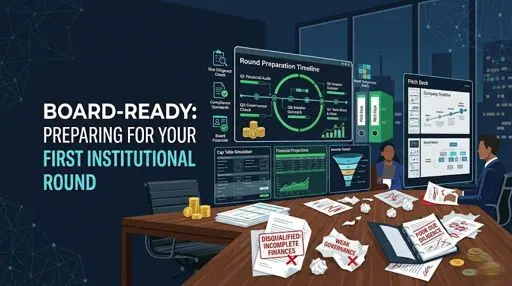
Founders approaching their first institutional round—typically a Series A—often focus entirely on the top-line metrics: revenue growth, unit economics, total addressable market (TAM), and customer acquisition costs (CAC). These matter. Without them, you don't get the meeting.
But sophisticated investors are equally interested in something founders frequently overlook: infrastructure readiness. They are assessing whether the company is structurally prepared to receive, manage, and deploy institutional capital responsibly.
Board readiness isn't about having a formal, independent board of directors in place today. Many pre-Series A companies operate perfectly well with founder-only boards or informal advisory circles. Readiness means having the governance scaffolding installed right now so a fiduciary board can function effectively the moment institutional investors join your cap table.
The "Pre-Diligence Autopsy"
Before you build your pitch deck, conduct a "pre-diligence autopsy" with your co-founders. Ask yourselves: If an auditor walked into our data room today, what would terrify them? Look for undocumented handshake equity, commingled personal/business expenses, and IP that hasn't been formally assigned to the corporate entity. Fix these before taking a single investor meeting.
The 2026 Reality Check: A Buyer's Market for Capital
To understand why governance matters now more than ever, you must look at the brutal reality of the 2026 funding climate. The venture capital environment is heavily bifurcated. While massive mega-rounds are still closing for foundational AI and defence tech, the broader market is experiencing a severe liquidity squeeze. With IPO windows tight and distributions to Limited Partners (LPs) remaining historically low, VCs are aggressively protecting their capital.
This means due diligence has been weaponised. Investors are actively looking for reasons to pass. In a high-velocity 2021-style bull market, VCs routinely overlooked a messy cap table or informal decision-making processes, assuming they could fix it post-close. Today, an institutional investor views "governance debt" as an acute operational risk that will drag down their own resources.
If a startup scrambles to produce basic historical financials, or if the founders are clearly making multi-million dollar decisions based on gut instinct without a paper trail, it signals a dangerous level of inexperience. Companies that treat governance as an afterthought find themselves negotiating valuations from a position of profound weakness.
Shift the Narrative
Stop pitching "growth at all costs." Shift your narrative to "defensible growth supported by scalable infrastructure." In your initial meetings, proactively bring up your financial controls and reporting cadence. When a founder says, "We close our books on the 10th of every month and have a clean 409A valuation," they immediately separate themselves from 80% of the pack.
What Investors Actually Evaluate: The 3-Pillar Framework
Experienced institutional investors look far beyond the polish of a pitch deck. They are assessing whether the company can absorb a $5M to $15M capital injection without fracturing. They evaluate this across three pillars:
1. Decision-Making Architecture
How are strategic choices made, and who is ultimately accountable? Investors want to see that the era of "the CEO decides everything over Slack" is over. They look for evidence that management debates strategy, documents decisions, and understands the difference between operational execution and strategic oversight.
2. Information Fidelity & Velocity
Can the company produce accurate, timely, and unaudited financials on demand? If it takes your fractional CFO three weeks to figure out your exact cash burn and runway, you fail this test.
3. System Scalability
Are the legal, HR, and financial frameworks capable of supporting complex board oversight, subsequent funding rounds (Series B/C), and multi-national operations?
The 3-Pillar Assessment Flow
Governance"] -->|"Institutional
Diligence"| B{"The 3-Pillar
Assessment"} B -->|"Fails 1+ Pillars"| C["Deal Friction /
Valuation Haircut /
Pass"] B -->|"Passes All Pillars"| D["Clean Term Sheet"] D --> E["1. Decision
Architecture"] D --> F["2. Information
Fidelity"] D --> G["3. System
Scalability"]
Regional Nuances: US, EU, and Australia
Governance expectations are not uniform globally. Where you are raising dictates the specific structural threshold you must clear.
The United States: Standardisation and Speed
The US venture market is a machine built on aggressive standardisation. Because US VCs write the largest cheques globally, their tolerance for structural anomalies is near zero.
The Standard: A Delaware C-Corp structure, standardised 4-year vesting schedules with a 1-year cliff, and highly documented intellectual property assignments (Invention Assignment Agreements).
US Recommendation
Use National Venture Capital Association (NVCA) standard document templates for your corporate foundation. Ensure you have a recent, defensible 409A valuation report before opening your data room. If you are operating as an LLC, prepare to convert to a C-Corp immediately.
The European Union: Fragmentation and Compliance
Raising in the EU presents a unique set of challenges due to heavy regulatory fragmentation across member states. Scaling a business out of Paris or Berlin means navigating cross-border tax implications, complex labour laws, and stringent ESG (Environmental, Social, and Governance) reporting mandates.
The Standard: EU investors expect strict adherence to GDPR, local labour councils, and clean subsidiary structures. Furthermore, if an EU startup eventually intends to raise US capital, its early board must proactively structure the company to handle a "flip-up" (creating a US holding company).
EU Recommendation
Consolidate your cap table. In many EU countries, early angel rounds result in dozens of direct shareholders, which paralyses decision-making. Implement a nominee structure or a pooling vehicle for early angels so investors only have to deal with one line item on the cap table.
Australia: Pragmatism and Director Liability
The Australian VC ecosystem is highly pragmatic, often forcing founders to focus on unit economics much earlier than their US counterparts. Crucially, Australian governance is heavily shaped by the Australian Securities and Investments Commission (ASIC) and strict "insolvent trading" laws.
The Standard: Directors in Australia face severe, personal civil and criminal liability if a company trades while insolvent. Therefore, Australian institutional investors demand rigorous, hyper-accurate cash-flow reporting from Day 1 to protect themselves.
Australia Recommendation
Have a robust Directors & Officers (D&O) insurance policy priced out and ready to execute upon funding. Build a rolling 13-week cash flow forecast that is updated weekly, demonstrating that management has total visibility into the company's solvency.
Regional Governance Focus Areas
Common Governance Gaps Founders Miss
When the data room opens, these four elements consistently catch founders off guard, slowing down deal velocity and running up massive legal bills.
1. The Board Information Package (The "Board Pack")
The Gap: Founders think a board meeting is just a pitch deck update. They provide unstructured "good news" updates via email, hiding the actual challenges the business faces.
The Fix: Investors expect a structured, metric-driven reporting cadence. A standard board pack should be delivered consistently 48 to 72 hours before every meeting so the actual meeting is spent discussing strategy, not reading numbers.
Your Minimum Viable Board Pack Must Include:
- Executive Summary: A 1-page memo from the CEO highlighting the top 3 wins, top 3 existential challenges, and exactly what the CEO needs from the board.
- Financial Dashboard: MRR/ARR, Burn Rate, Runway (in exact months), Gross Margins, and Cash on Hand vs. Budget.
- Department Updates: 1-2 slides max per department (Sales, Product, Engineering) highlighting KPIs vs. targets.
2. The Delegation of Authority (DoA) Matrix
The Gap: In the early days, the CEO signs every contract and approves every hire. As you scale, investors need to know exactly what management can do unilaterally, and what requires board consent. The absence of a DoA creates ongoing friction and slows down operations.
The Fix: Draft a clear, one-page Approval Matrix.
It's worth noting that DoA provisions may already exist in your seed-round or founder Shareholders Agreement (SHA). If so, two things matter: first, review these provisions carefully to ensure they remain commercially appropriate and investor-friendly for your Series A—thresholds that made sense at a $500k seed round often become operationally paralysing at scale. Second, even if the SHA contains robust approval requirements, extract them into a standalone document that management can reference without needing to consult the full agreement. A one-page DoA matrix pinned to your internal wiki is infinitely more useful than buried clauses in a 40-page legal document that nobody reads.
| Decision Category | Management Can Approve | Requires Board Approval |
|---|---|---|
| Hiring & Compensation | Any hire under $150k base | C-Suite/VP hires, or equity grants outside the standard option pool |
| Capital Expenditures | Unbudgeted spend under $25k | Any unbudgeted spend >$25k |
| Legal & IP | Standard NDAs and vendor MSAs | Exclusivity agreements, settling lawsuits, selling IP |
| Cap Table | N/A | Issuing new shares, altering vesting schedules, taking on debt |
3. Cap Table Hygiene
The Gap: Complex, non-standard, or poorly documented equity structures—like handshake agreements with early advisors, overlapping vesting schedules, or undocumented convertible notes (SAFEs).
The Fix: Move off Excel immediately. Migrate your cap table to a digital platform (e.g., Carta, Pulley, or SeedLegals). Run a pro-forma model showing exactly what happens to the cap table when all outstanding SAFEs and convertible notes convert at your target Series A valuation. Surprises here kill deals.
4. Key Person Dependencies
The Gap: The concentration of critical intellectual property, core code, or key enterprise relationships entirely within the founders, without documentation or succession planning.
The Fix: Ensure every single employee, founder, and contractor has signed an Invention Assignment Agreement (assigning all IP to the company). Document core operational processes so the company doesn't grind to a halt if a founder is incapacitated for a month.
The Practical Minimum: A 30-Day Roadmap to Readiness
You do not need Fortune 500 bureaucracy. You need evidence of operational maturity. Follow this 30-day roadmap before you officially start raising:
30-Day Board Readiness Roadmap
Days 1–10: The Cleanup Phase
Audit Legal Docs: Have your startup counsel verify that all IP is assigned to the corporate entity and that the corporate structure is clean (e.g., standard Delaware C-Corp or regional equivalent).
Digitise the Cap Table: Ensure all SAFEs, options, and equity grants are loaded into software and mathematically tie out.
Days 1-10Days 11–20: Financial & Operational Controls
The "Close" Test: Ensure your accounting team (internal or fractional) can confidently close the books and produce a P&L and Balance Sheet within 15 days of month-end.
Draft the DoA: Create your first Delegation of Authority matrix based on the table above.
Days 11-20Days 21–30: The Governance Rehearsal
Build the Board Pack Template: Design your standard reporting deck with all the components listed above.
Hold a Mock Board Meeting: Even if it's just the co-founders, circulate the board pack 72 hours in advance. Spend 90 minutes acting like a fiduciary board—focusing purely on capital allocation, existential risks, and executive accountability.
Days 21-30Control the Narrative
The goal is not to drown your startup in red tape. The goal is to demonstrate that your executive team understands the weight of institutional capital and has laid the foundation to deploy it efficiently.
Investors back teams that anticipate the future. Those who prepare their governance in advance don't just survive the diligence gauntlet—they control the narrative, maintain their valuation, and close faster.
In a buyer's market for capital, governance readiness isn't a nice-to-have. It's the difference between a clean term sheet and months of painful renegotiation. The founders who understand this will be the ones who close their rounds while others are still scrambling to produce basic financials.